5 titles · in the order the archive depicts them. A series counts once, regardless of however many of its episodes carry the tag. 1 title here is set entirely outside the boundaries above, which is usually a period bounded more narrowly than a title that touches it.
The Chronicle
The events and themes the archive follows through Crisis of the Roman Republic, in the order they happened, each with the titles that depict it. Press a name to read about it in the threads below.
A decisive victory by Julius Caesar against the confederation of tribes led by Vercingetorix, concluding the Gallic Wars and bringing Gaul under complete Roman occupation.
The periods the archive counts as part of Crisis of the Roman Republic. Their titles are gathered on this page where they are set inside its boundaries. The number represents how many titles in these sub-periods are also directly attached to this period and how many are just inherited rather being directly tagged with Crisis of the Roman Republic.
Every title set during Crisis of the Roman Republic, by the decade it came out. A series is placed on the chart by its first season and counts as one title entity.
FilmsSeriesAt the archive’s paceeach bar is the titles released that decade
The median title about Crisis of the Roman Republic came out in 1963; the median across the rest of the archive, in 2004, so this period’s titles run 41 years earlier.
The gold dashes are how many of this period’s 5 titles each decade would hold if they had been released at the same pace as the other 286 dated titles in the archive. That measures the archive’s own collecting, not the world’s film output, and at these sizes one title moves a bar by a whole step.
Cast of Characters
The historical people the archive’s titles put on screen in this period, grouped by what they are known for. The number is how many titles set here they appear in.
A thread follows one event or historical theme across the archive, wherever and whenever it appears. Pick a tab to read one; they are in the order they are filed on the timeline. Pulling a thread opens up a narrowed timeline view filtered to every year that thread touches.
A decisive victory by Julius Caesar against the confederation of tribes led by Vercingetorix, concluding the Gallic Wars and bringing Gaul under complete Roman occupation. The battle was made famous by Caesar's siege tactics, wherein, while Vercingetorix's forces within the city of Alesia waited for a relief army to attack the Roman force keeping them trapped, Caesar, instead of breaking the siege, built two sets of defenses at once, one to pin Vercingetorix within Alesia and another to repel his reinforcements. The Romans were able to defeat both forces from within the two sets of defensive barriers.
The pivotal naval engagement between the forces of Octavian and the combined navy of Mark Antony and Cleopatra VII off the coast of Actium in Greece. After suffering badly at the hands of a surrounding Roman force, Antony's forces were routed, fleeing to Egypt where they were ultimately defeated at Alexandria, spurring Antony and Cleopatra to take their own lives and paving the way for Octavian's ascendance as Augustus, first Emperor of the Roman Empire.
Every place the archive’s titles set in this period name, with each one nested under the larger place it sits inside where that place is here too. The number is how many titles set here name it.
No title set here has been given a saltiness score yet. That is unrated, which is not the same as accurate.
Archive Density
80%4 of the 5 titles the archive sets between 133 BCE and 27 BCE carry the Crisis of the Roman Republic tag.
80%With its sub-periods: 4 of the same 5 titles carry Crisis of the Roman Republic or one of Gallic Wars.
This measure can help illustrate cinematic hotspots within a time period by comparing which years of the overarching, actual historical time period are backed up by a cinematic release.
12 years on the timeline fall inside the boundaries, 3 of them with nothing set there yet. The dark part of each bar is the share carrying this period; the lighter part beside it, the share carrying one of its sub-periods instead.
Share of the 11 genre taggings across 5 titles set in this period. A title filed under three genres is in three of these slices, so this is a share of taggings rather than of titles.
Films only. Co-directors are counted individually, so a director’s solo work and their collaborations are grouped together. Average saltiness ignores any title still unsalted.
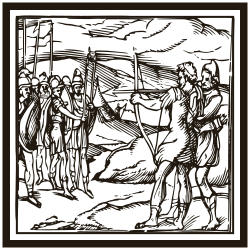
The record: Armies from antiquity until past the Napoleonic period fought in formation because individual soldiers are vulnerable. Battles were usually contests between blocks of men holding together, and the side whose formation broke first usually lost. Further, maintaining clear formations was essential to maintaining battlefield operations and communication, both for commanders to be able to give orders to their subordinate officers as well as for individual soldiers to know where to rally and position themselves.
Part of and part of it are declared by the archive: one period counted as belonging to another, whatever their dates. Periods overlap freely so concurrent means the two spans share years, and the shared stretch is named. Bounded means it lies wholly inside this one, beginning and ending more than 10 years within its boundaries. Before and after are the nearest periods lying outside this one, with the gap in years shown instead. A shared thread is what the two have in common besides the calendar, and a period lying wholly outside this one can still share one.
Periods before, during, inside and after Crisis of the Roman Republic, with their year ranges, the years they share with it, the threads they share with it, and how many titles the archive holds of each.